UK & Europe | Investigations & Public Interest
Telling survivor truths. Protecting sources. Holding cults to account.
Sham Aberdeen Ambush
- Aberdeen
- Exclusive Brethren
- James Taylor Jr
- Scotland
- Plymouth Brethren
Aberdeen, July–October 1970
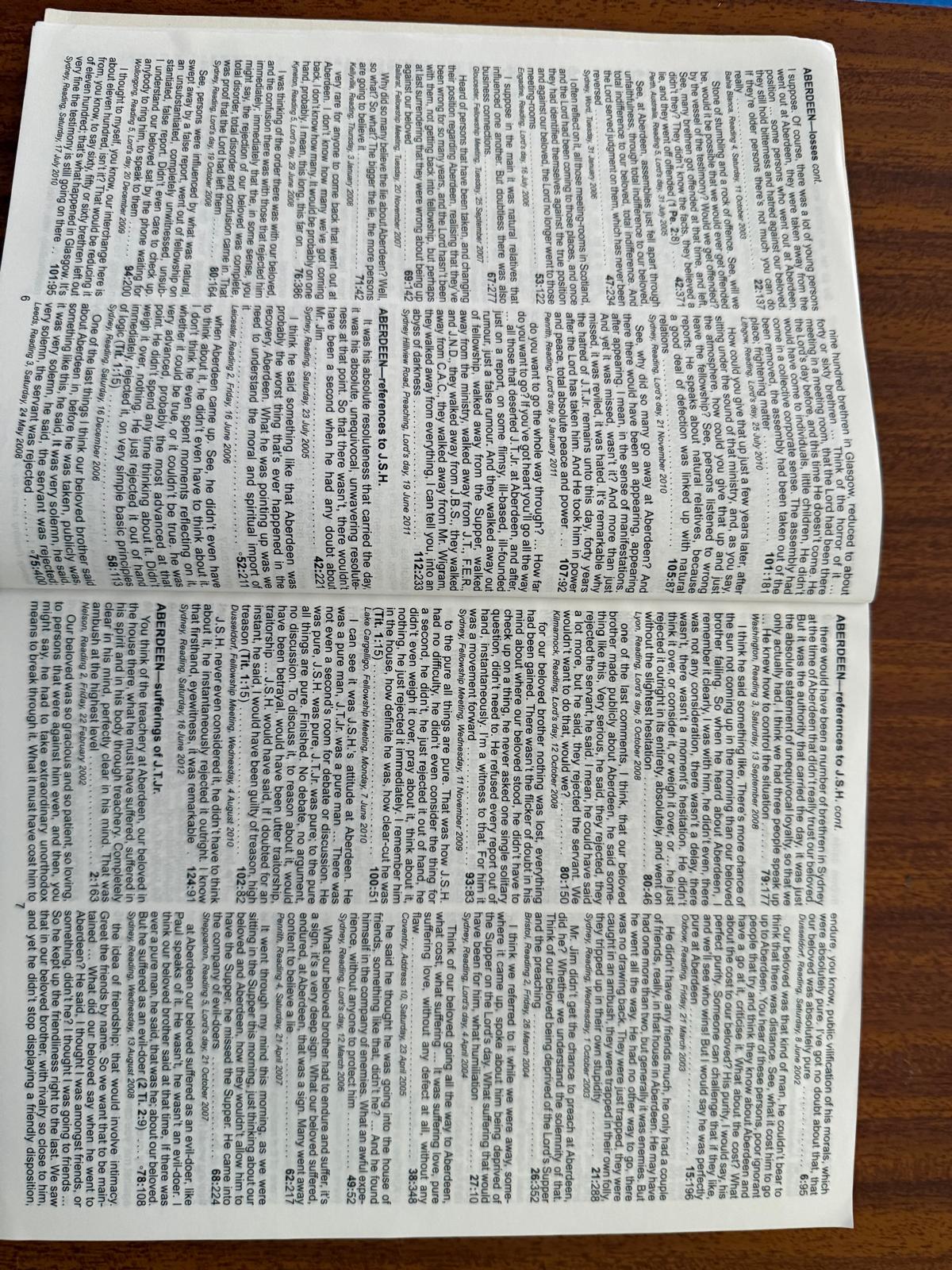
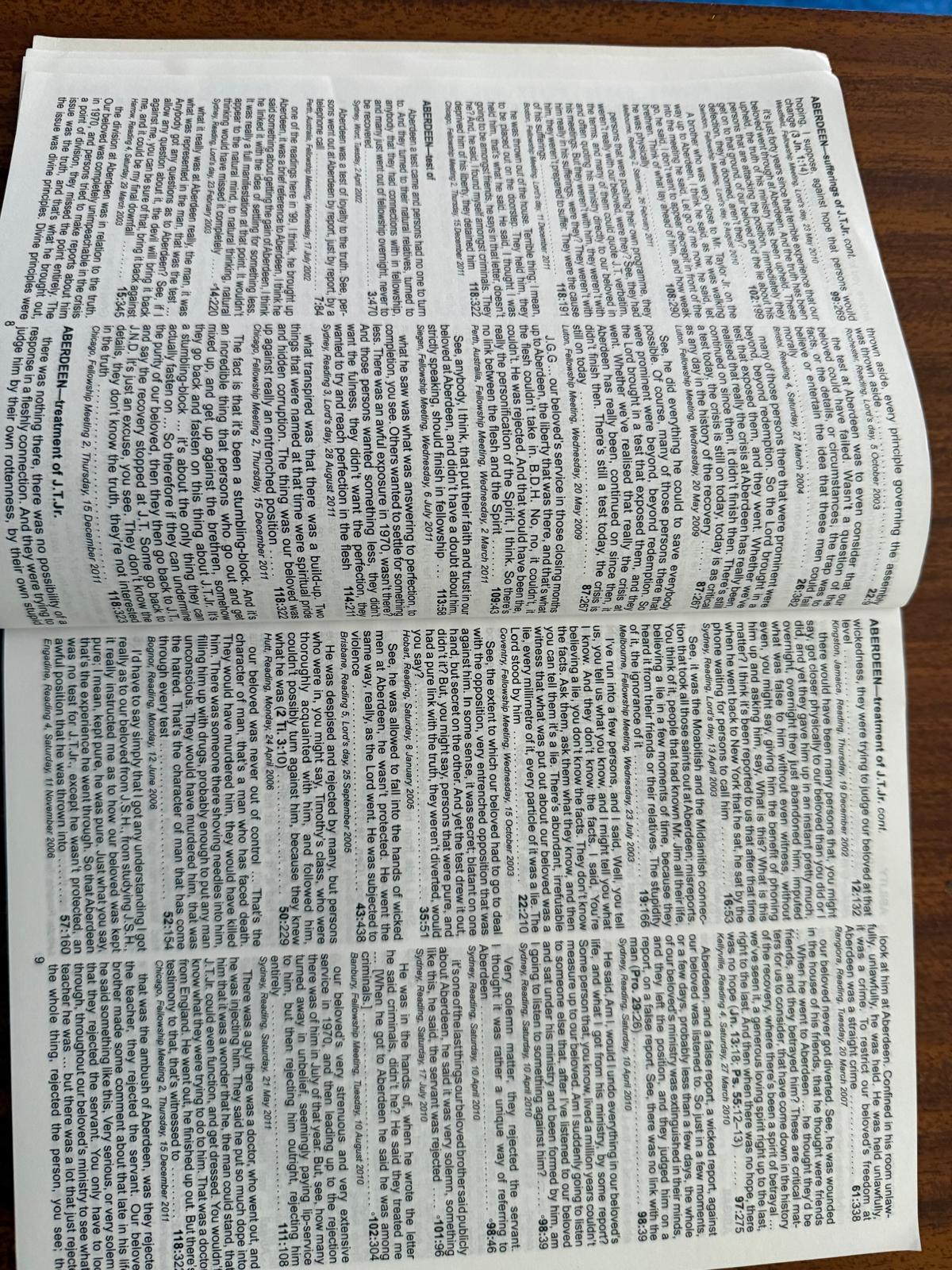
For years after the weekend, and still in ministry indexed under Bruce D. Hales between 2002 and 2012, Aberdeen was taught inside the fellowship as a lie against a holy man of God, an ambush, a test. Those who left were said to have been “caught up in the stupidity” of believing that lie. The same index records John S. Hales rejecting the host reports as “completely unsubstantial, unwitnessed, unsubstantiated, false.”¹
That is the memory the fellowship still needs. What follows is the dated paper that memory has to bury.
A bungalow on the Aberdeen outskirts. A bedroom door. A meeting hall with five hundred people and three tape recorders running. Telephones ringing south through the night. A press that printed nearly everything the Exclusive Brethren read. Eighty days later the man at the centre of it was dead in Brooklyn, and a worldwide fellowship was split in two. His death, and what followed it, come later in this account. First the weekend that made both inevitable.²
Where the facts were better known, Taylor’s account failed. Where relationships could be controlled by telephone and circular, the burial mostly worked. That distance was not incidental. It is how a scandal can be kept and Scotland lost.³
In 1970 James Taylor Jr. was JT Jr., Big Jim, the Man of God: universal leader of the Exclusive Brethren since 1959, ruling a separated worldwide company from Brooklyn with his wife, Irene. He was seventy. Separation was not a metaphor. Since 1960 his “Separate Tables” doctrine had torn families apart. Members could not eat with outsiders, including, in documented cases, their own spouses and children sitting at another table in the same house. At Chesterfield and Horsham he told questioners that Brethren must withdraw from the world “in toto” and become “a Separate People.” The northeast Scottish fishing ports (Peterhead, Gardenstown, Findochty, Macduff) had long been Brethren strongholds.⁴
The scriptural charter, in the Darby Bible they used, was 2 Timothy 2:19: Let every one who names the name of the Lord withdraw from iniquity. Withdrawal meant the loss of table, marriage prospects, and the company of the saved. Disagree with the Man of God and you lost the life that made disagreement possible. That penalty is the machinery of everything that follows.⁵
Aberdeen did not invent that enclosure. Neil Dickson, writing in Religions in 2022, notes that the Taylorite meetings in Scotland had already been losing people through the 1960s as assemblies seceded over the new requirements. Michael Bachelard records Taylor referring to those who left as “profitable losses.” July 1970 made the closed system public. It did not create it.⁶
Thursday
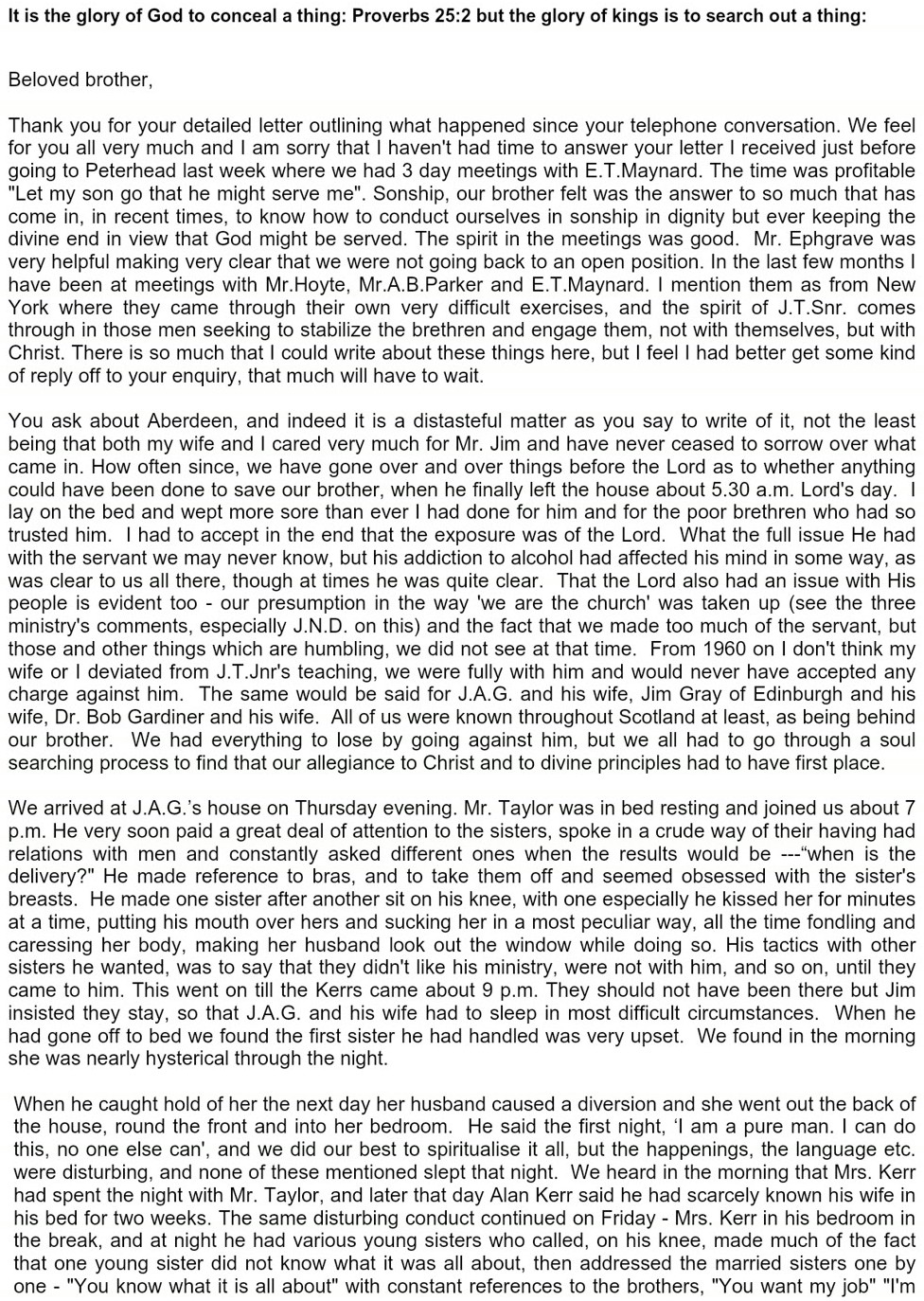
On Thursday 23 July he flew into Aberdeen by charter and was billeted at Airylea, a bungalow in Nigg, with James Alexander Gardiner, an Aberdeen fisherman and leading local brother. Other guests included Ted and Joan Steedman of Falkirk. They had been with Taylor since 1960. Steedman later wrote that they “would never have accepted any charge against him,” and that the same was true of Gardiner and his wife: “We had everything to lose by going against him.”⁷
That evening, before Alan and Madeline Ker arrived, Steedman watched Taylor turn on the sisters in the house: crude talk of sexual relations, bras, lap-sitting, prolonged kissing while a husband was told to look out the window. Taylor said the first night, Steedman recorded: “I am a pure man. I can do this, no one else can.” They tried to spiritualise it. None of them slept.⁸
Two months earlier, in May 1970, on the same summer tour, a former member, Alan Robertson, alleged that Taylor had raped him as a boy after a meeting in Kilmarnock. The allegation was later published by Michael Bachelard (2008) from Robertson’s then-unpublished manuscript, and reported by Mark Nicol in the Mail on Sunday on 27 January 2013. The Plymouth Brethren Christian Church denied it and said an internal investigation had found it untrue, including as to whether Taylor visited Kilmarnock that year.⁹
The Kers, a London couple, landed on a scheduled BEA flight at half past nine. They had been due to stay elsewhere. Taylor insisted they remain at Airylea. Gardiner watched Alan lead Madeline, barefoot and in a dressing gown, to Taylor’s bedroom. Alan returned alone. One sister, Steedman wrote, was nearly hysterical overnight.¹⁰
Friday
Mrs Gardiner saw Madeline leave that room at dawn, still barefoot, still in a dressing gown. Between sessions at the Brethren meeting hall on Rosemount Viaduct in Aberdeen, Mrs Ker spent intervals back in the bedroom. A “meeting,” for anyone outside this world, was not a coffee morning. It was hours of ministry under the Man of God’s authority. The Aberdeen series was billed for three days. On Saturday about five hundred people would pack that hall.¹¹
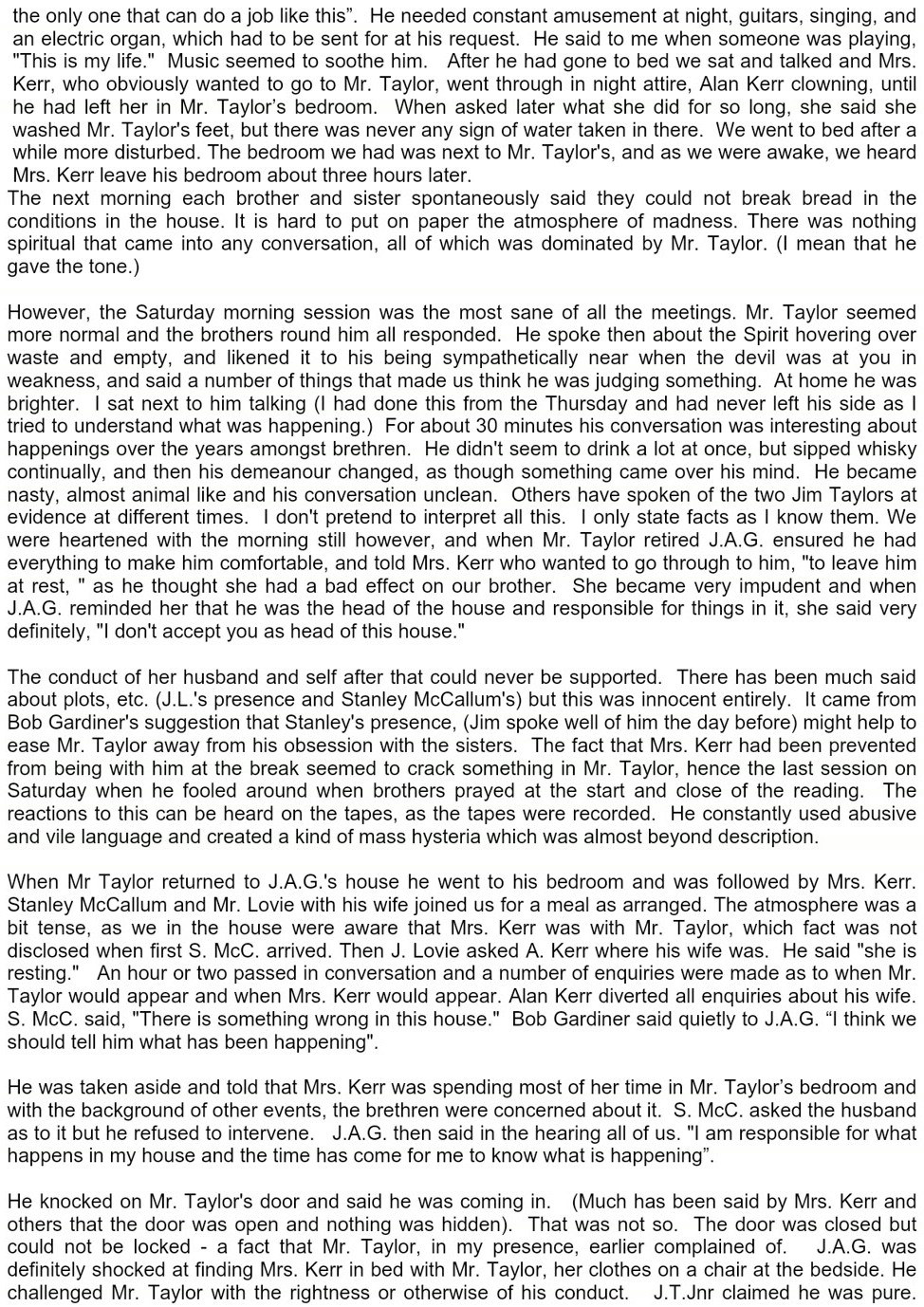
At the foot of Taylor’s chair sat a glass of mixed whisky. He drank through the day as the ministry proceeded on Abram the Hebrew. Alan Ker told him his wife wished to wash his feet; Taylor agreed, and accepted the suggestion of head massage after the meetings. That night Ker brought Madeline through several rooms of the house to Taylor’s room. Helpers saw them enter. At eleven, the host statement records, Alan led her there again and returned alone. Steedman, in the next bedroom, heard her leave about three hours later. She said she had washed Taylor’s feet.¹²
There was never any sign of water taken in.¹³
Saturday
Saturday morning was not fallout from a discovery. It was the house trying to stop what it had already seen.
Gardiner barricaded the door between the Kers’ quarters and the living room. The Kers forced it. A glass panel cracked. When Gardiner told Madeline to leave Taylor at rest, she said she did not accept him as head of the house. She got through anyway. Taylor was late for the afternoon meeting. She told Gardiner he was a “S.O.B. and a bastard.” Steedman later judged that keeping her from Taylor in the interval between meetings “seemed to crack something” in him; that denial, he thought, was why the afternoon session went the way it did. By then the hall was waiting.¹⁴
Five hundred people filled the Rosemount Viaduct hall for the Saturday afternoon session. Three tape recorders, Steedman recalled, were running. Norman Adams, a Scottish Daily Express reporter who later published Goodbye, Beloved Brethren (1972), reproduces the transcript and describes whistling, cat-calls, and stomping. Taylor’s speech is marked “very slurred.” He appeared on the platform barefoot during the Saturday gospel meeting.¹⁵
Hear the hall.
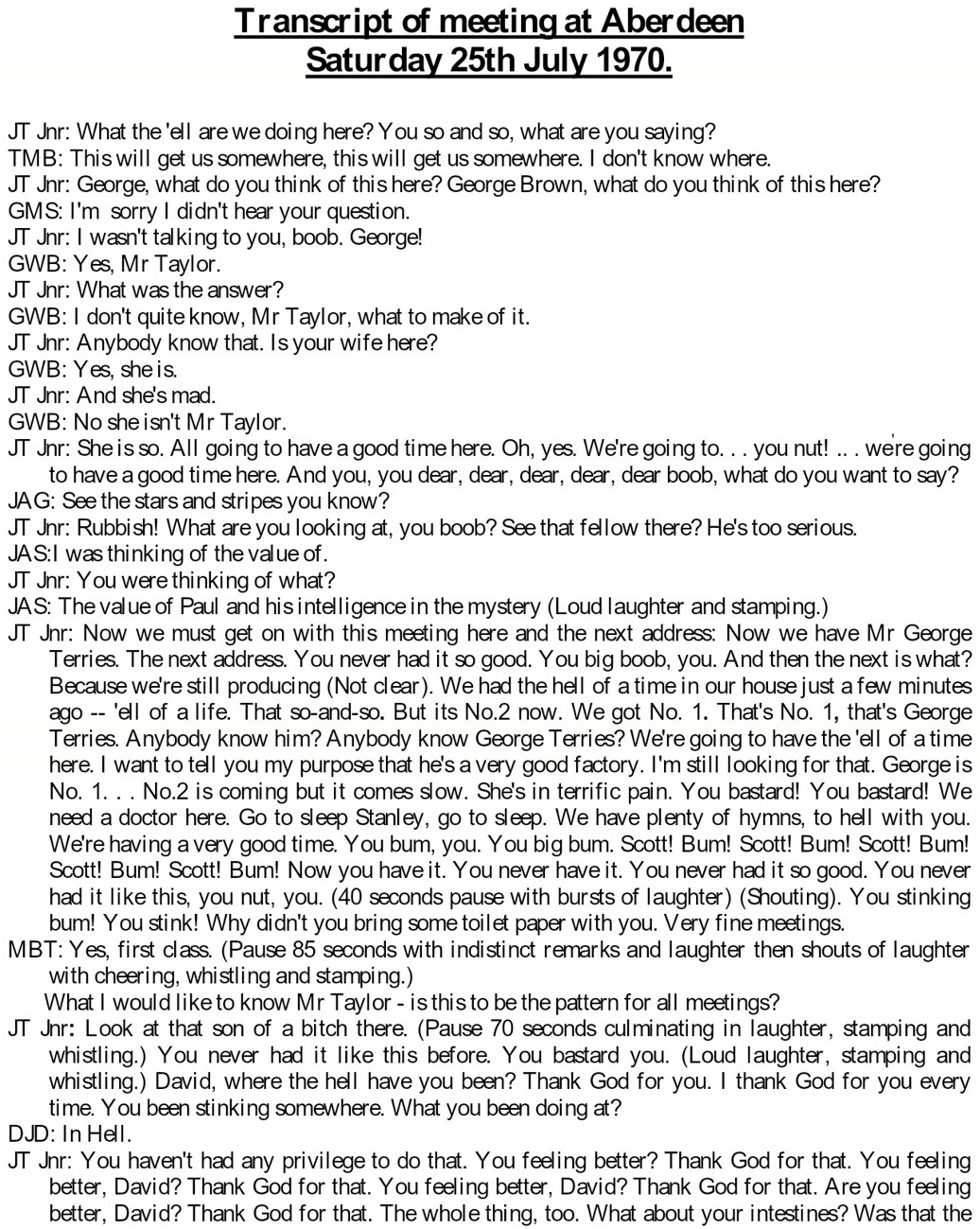
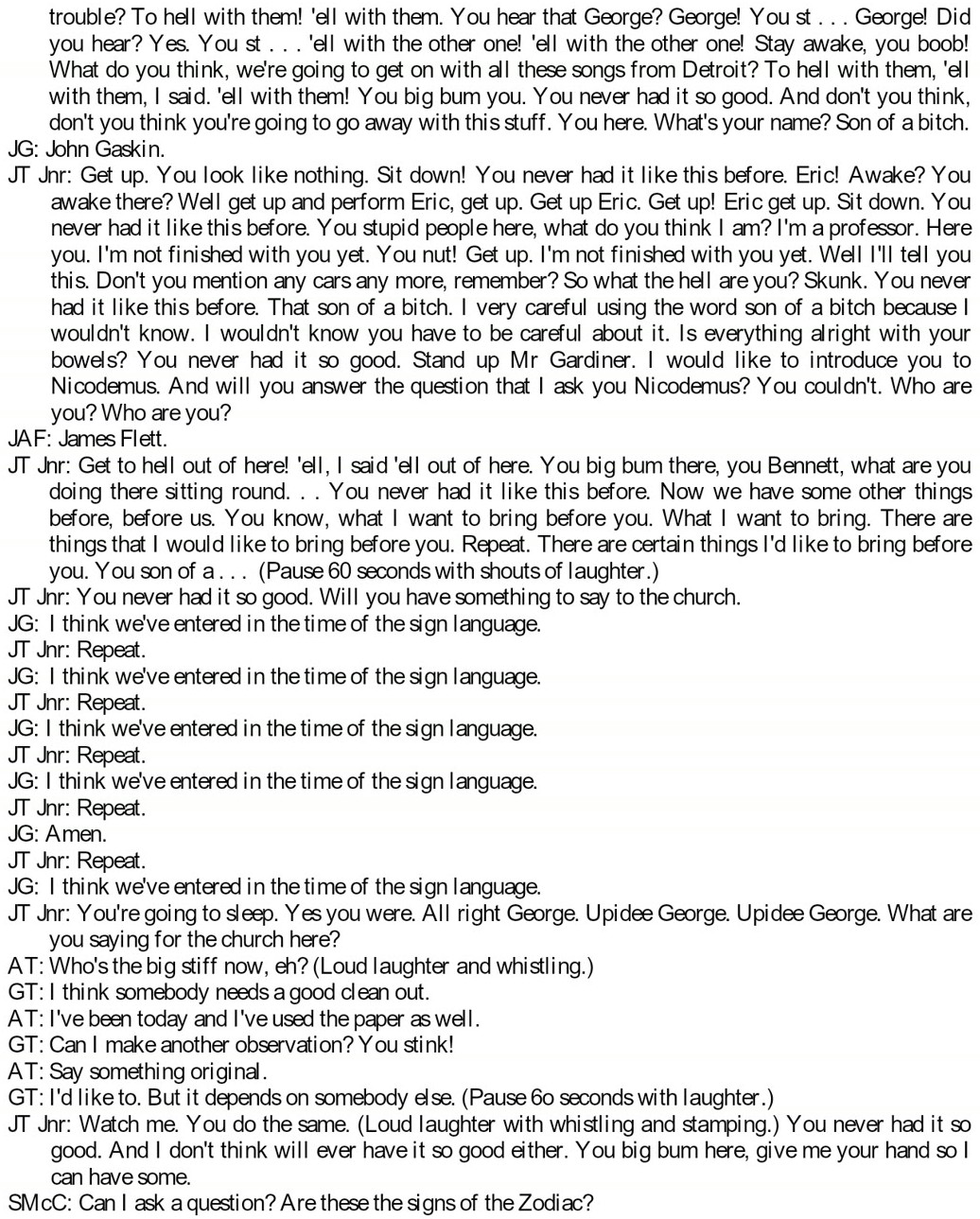
When that session ended, the reels of tape went into the post. The bungalow was still ahead.
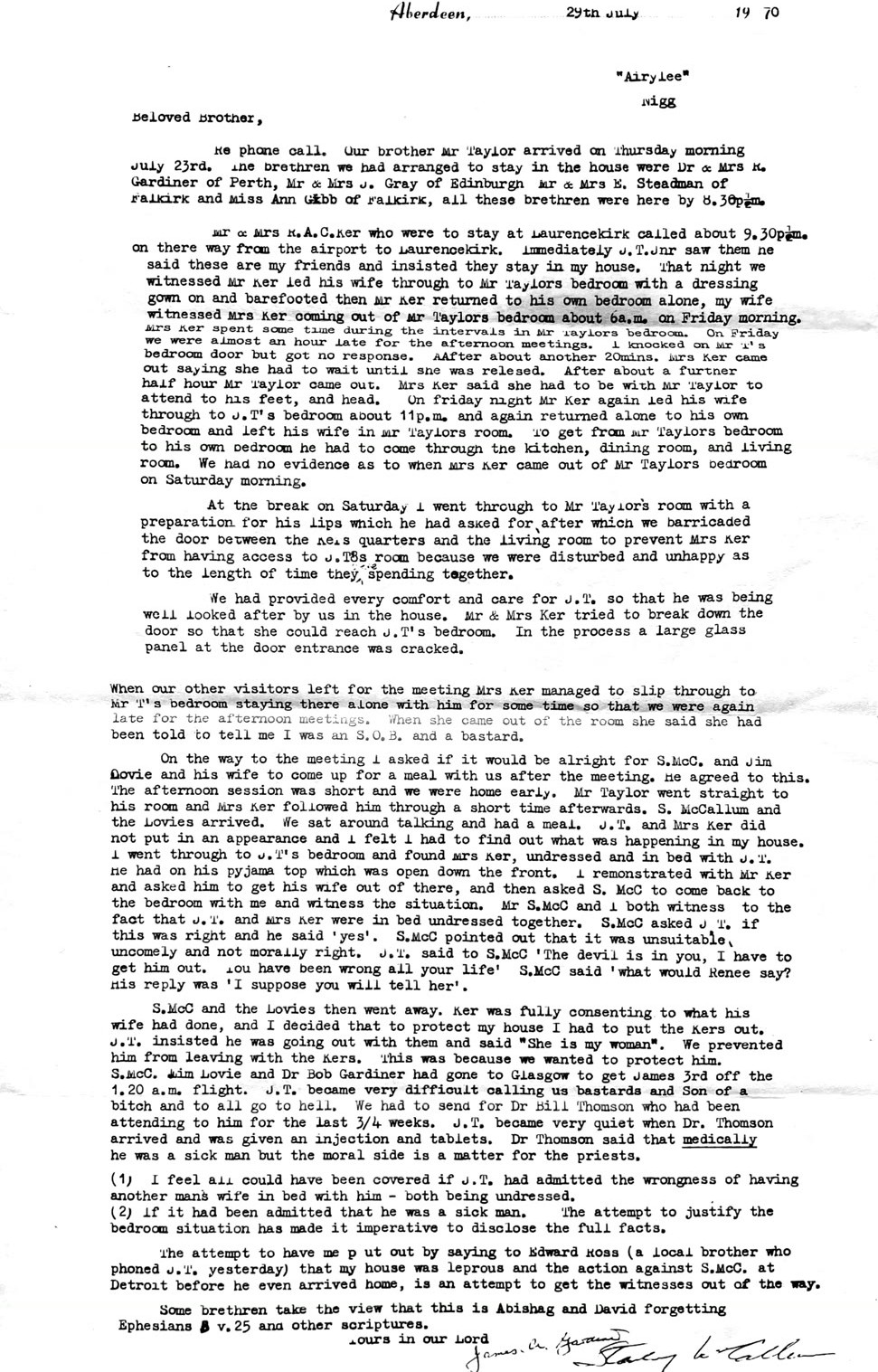
McCallum and the Lovies came to Airylea for a meal, as arranged. Taylor had gone to his room. Mrs Ker followed. Gardiner entered and found her undressed in bed with Taylor. McCallum was brought as witness. Taylor’s pyjama top was open down the front. Both men would sign, four days later, that the two were in bed undressed together. Taylor said, in the statement’s wording, “She is my woman.” Steedman, in the house, heard “That’s my woman.” Taylor became verbally abusive toward his hosts: “bastards,” “son of a bitch.”¹⁷
Gardiner ordered the Kers out. Taylor tried to leave with them. The hosts stopped him, saying they meant to protect him. Dr Bill Thomson gave injections and tablets and said that medically Taylor was sick, but “the moral side is a matter for the priests.” Taylor refused to say he was sick. That sentence is the fellowship’s own split in one line: the body may be treated; the priesthood decides what the bedroom meant.¹⁸
McCallum telephoned Taylor’s son, James Taylor III (known in the fellowship as James 3) at Farnham, telling him his father was sick, senile, and did not know what he was doing. James 3 left the Farnham meetings to collect him. In the small hours of Sunday, somewhere between four and half past five, Taylor left with his son. Steedman records that Dr Bob Gardiner raised £150 for the fare. Taylor refused to break bread in the house. No Lord’s Supper (the weekly communion that defined Brethren fellowship) was held at Airylea that weekend: the household, Steedman wrote, judged they could not break bread in the conditions there. After Taylor left, Steedman lay on the bed and “wept more sore than ever I had done for him and for the poor brethren who had so trusted him.” He concluded that “the exposure was of the Lord.”¹⁹
Gardiner’s signed conclusion was spare. The matter might have been contained if Taylor had admitted the wrongness of another man’s wife in his bed, both undressed. Justification made disclosure imperative. That is the moral hinge of the weekend: not exposure for its own sake, but the refusal to call the scene what it was.²⁰
The race
That same Saturday night the calls began from Aberdeen.
One call reached Robert Stott in Hove, a trustee of the Stow Hill Bible and Tract Depot at Kingston upon Thames, the press that printed and posted nearly everything the Exclusive Brethren read. Rebecca Stott later described her grandfather taking the news “like a grenade clutched to his heart.” He summoned his son Roger. Neither man could have known, that night, how the story would end. What they understood immediately was narrower and more urgent. Whatever they did next, other Brethren across the south of England would follow their lead. And somewhere in Brooklyn, another account of that bedroom was already forming. They decided they had to reach as many Brethren as possible “before any counter stories from New York set like concrete around them all, before the Hales supporters got hold of the Depot.”²¹
The Hales were an Australian Exclusive Brethren family already powerful in the Taylor orbit. Their line would later produce Bruce D. Hales, today’s universal leader of the Plymouth Brethren Christian Church. The family name feared at the Depot in 1970 is the family name on today’s letterhead. In 1970 the fear was simpler: if their supporters controlled the Depot, the Aberdeen account would not be the one that went into the post.²²
On Tuesday 28 July, at Vale Avenue in Brighton, about four hundred and fifty Brethren met with one item on the agenda: Aberdeen. John Railton, the local Taylor hardliner, called the rumours conspiracy. Roger Stott rose to report what he had been told and was withdrawn from fellowship before he finished a sentence. Another brother, named only as William in Rebecca Stott’s memoir, asked whether the Man of God could “do anything,” and was withdrawn from fellowship for asking. The chant that followed was blunt: Get. Out. You. Bastard. When Railton said that if Taylor had wanted his own wife in bed he would have felt honoured, Robert Stott stood, refused to condone Aberdeen, and walked. About two hundred followed. By evening the wives were packing; a kettle was going; six-year-old Rebecca was listening from the top of the stairs. Two of the Depot’s four trustees were now among those who had walked. One had the keys. Somewhere in the postal system was a reel of tape both sides needed. Roger typed the witness letters and transcribed the Aberdeen recording at the Depot. Robert edited the pamphlet If We Walk in the Light. It was still at the printer when Taylor died. Once printed, it moved through the Depot’s existing mailing network to “white booklet” subscribers, the worldwide list that already received Stow Hill’s regular ministry pamphlets. The rush was not abstract theology. It was a race for print, keys, and the post.²³
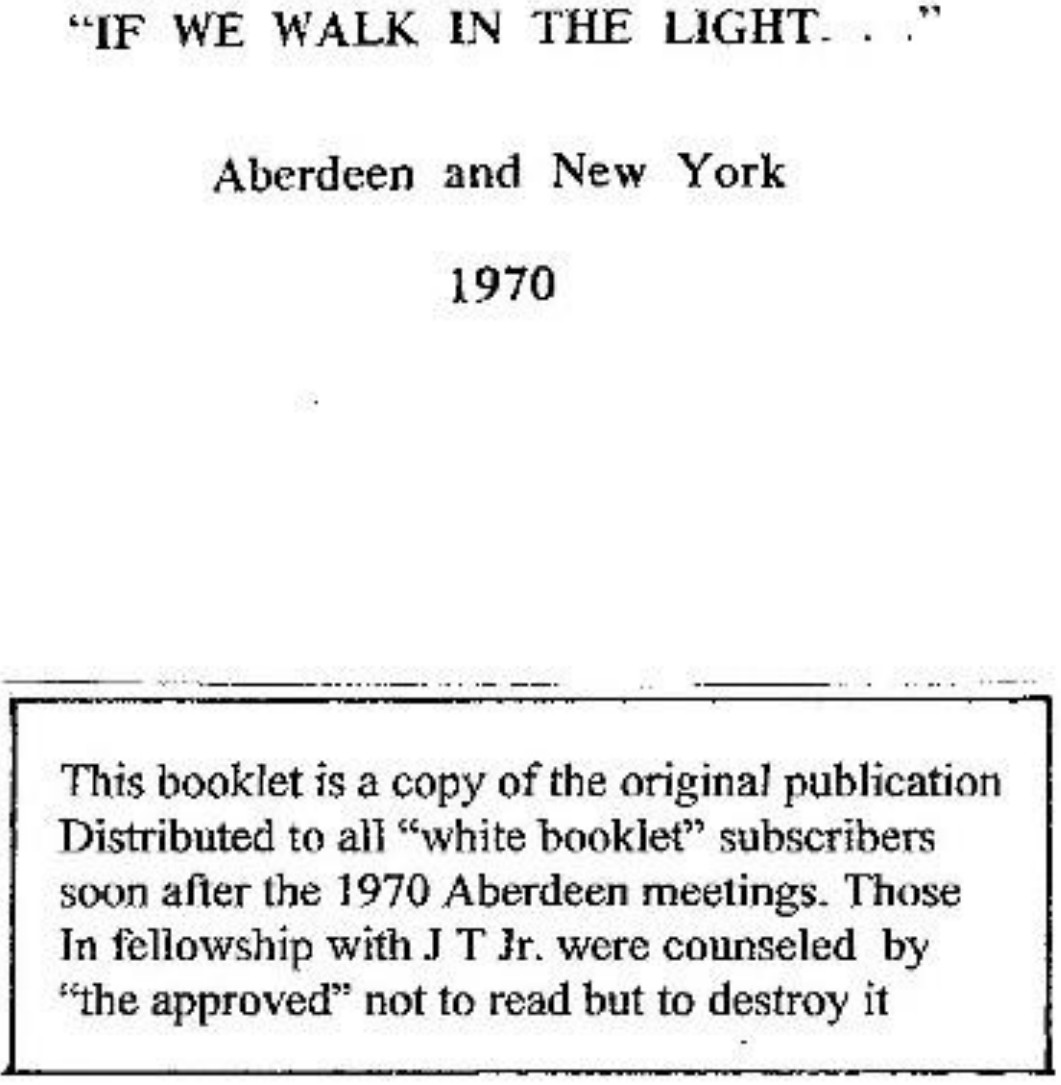
The cover carried a destroy order. Those still in fellowship with JT Jr. were counselled by “the approved” not to read the booklet but to burn it.²⁴
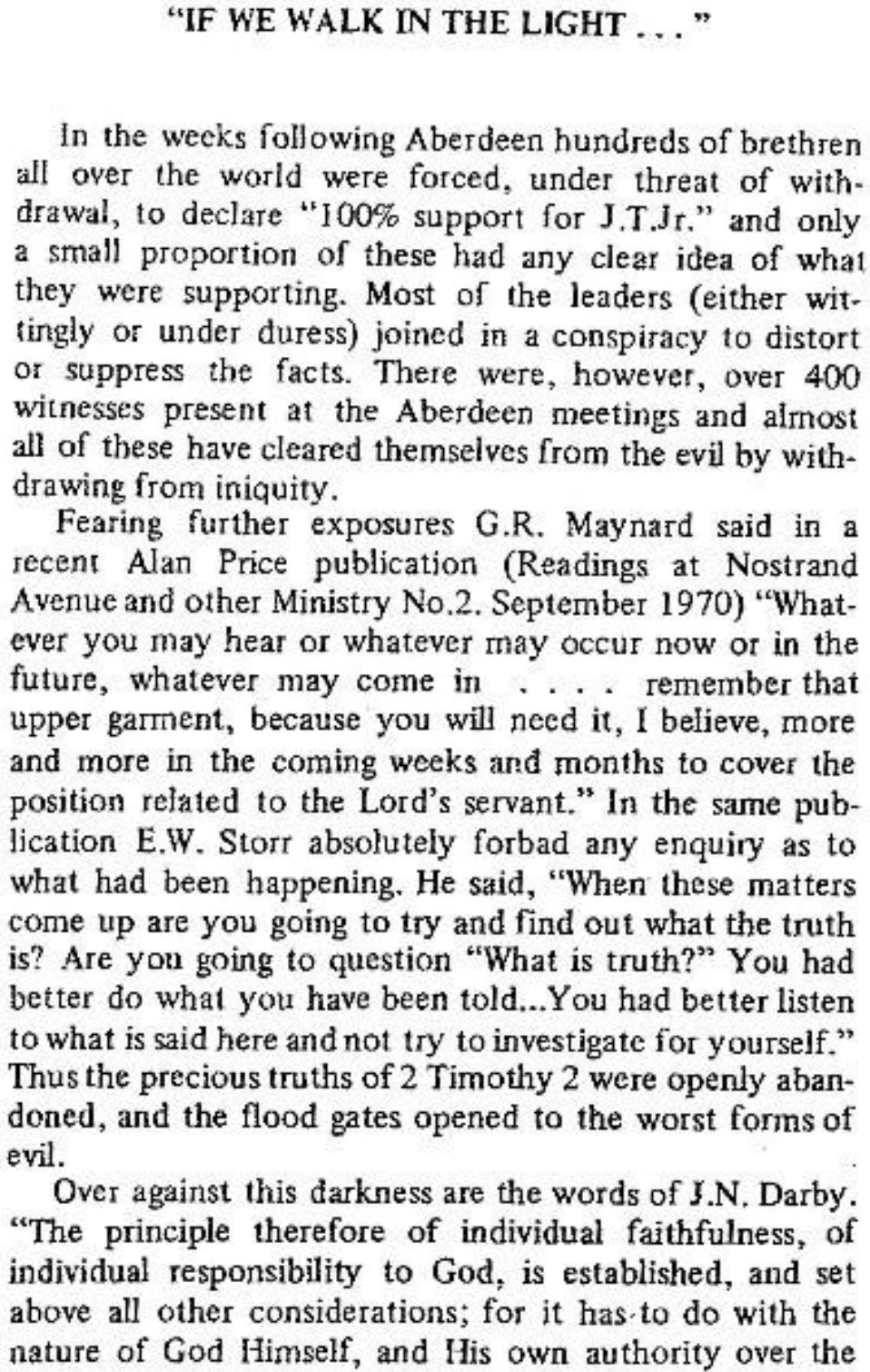
Robert Stott’s introduction recorded what followed in the weeks after the weekend: hundreds of brethren “forced, under threat of withdrawal, to declare ‘100% support for J.T.Jr.’” Most of the leaders, he wrote, “joined in a conspiracy to distort or suppress the facts.” There were, he said, over 400 witnesses at the meetings. G. R. Maynard, fearing further exposures, told hearers to remember “that upper garment … to cover the position related to the Lord’s servant.” E. W. Storr forbade enquiry: “You had better listen to what is said here and not try to investigate for yourself.”²⁵
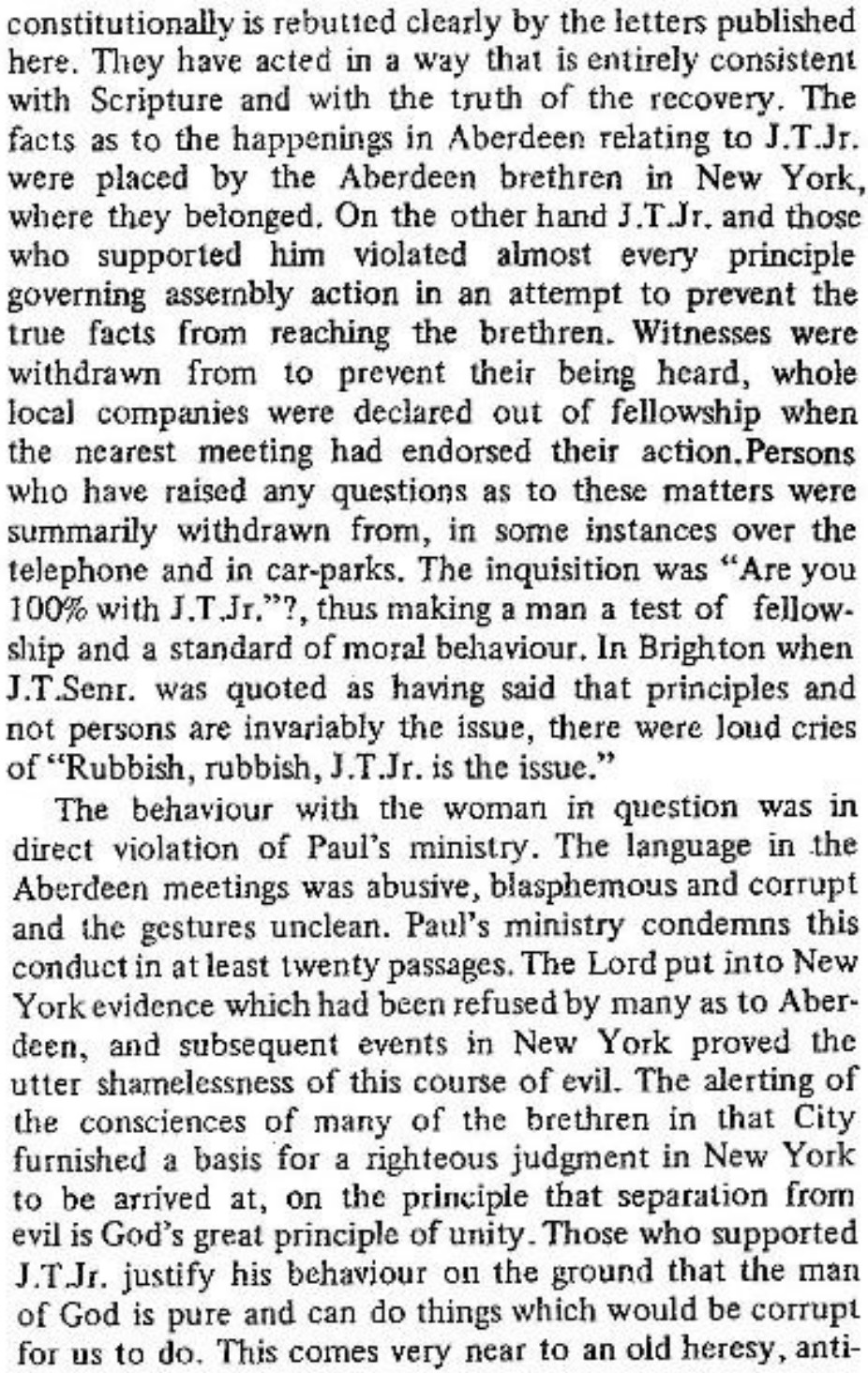
The pamphlet named the question put to brethren after Aberdeen: “Are you 100% with J.T.Jr.”? In Brighton, when J. T. Senr. was quoted as saying that principles and not persons are the issue, there were loud cries of “Rubbish, rubbish, J.T.Jr. is the issue.”²⁶
On 29 July Gardiner and McCallum signed their statement (that they had found Mrs Ker undressed in bed with Taylor, and that he had claimed her as his woman) and sent it, with the tapes, to A. Bufton Parker, a leading New York brother. The Aberdeen assembly backed Gardiner and repudiated the meetings. The same day Taylor preached on “Purity” at Nostrand Avenue in Brooklyn.²⁷
The counter-story sets
The same Tuesday, McCallum flew to Detroit. Taylor had already telephoned ahead. As McCallum left the aircraft he was cast out of fellowship: withdrawn, cut from the Lord’s table and from the company of the saved, before he could speak. Contact with the evidence had become a disciplinary offence.²⁸
Rewind a few hours and the method is already on paper.
On Wednesday forenoon Parker and two New York brethren reviewed Aberdeen with Taylor at his Brooklyn home; Adams records Taylor as uncooperative. That evening Taylor withdrew fellowship from Parker by telephone for associating with persons under discipline in Aberdeen. At a New York Care meeting soon after, Adams records, Taylor called the Aberdeen tape a forgery. The reels had already left Aberdeen in the post before that claim was made.²⁹
On 12 August a letter from Taylor to Elizabeth M. Hindle was circulated to roughly eight thousand followers. Hindle was an English Brethren sister who had written to thank him after Aberdeen; he said he did not remember her. The letter did two different jobs at once.
First it renamed the Aberdeen hosts. “The last time I was there I met the Press which was very interesting. This time I met criminals.” Later: “These were the criminals…”
Separately it answered a charge that had already been put by F. D. Waterfall, a well-known Birmingham minister among the Brethren in the 1960s and still a leading brother there. Waterfall’s accusation was the bedroom itself. Taylor’s reply was not a denial of detail. It was contempt and geography: “The charge made by that bastard Waterfall that I was in bed with another man’s wife is a dastardly lie. If I wanted to sleep with another man’s wife would I go to Aberdeen — costing about $1,000? Brooklyn would be cheaper.”
Hosts as criminals. Waterfall’s charge as a dastardly lie. Aberdeen as proof of innocence because the flight was expensive. The method is visible in consecutive sentences; the targets are not the same quarrel.³⁰
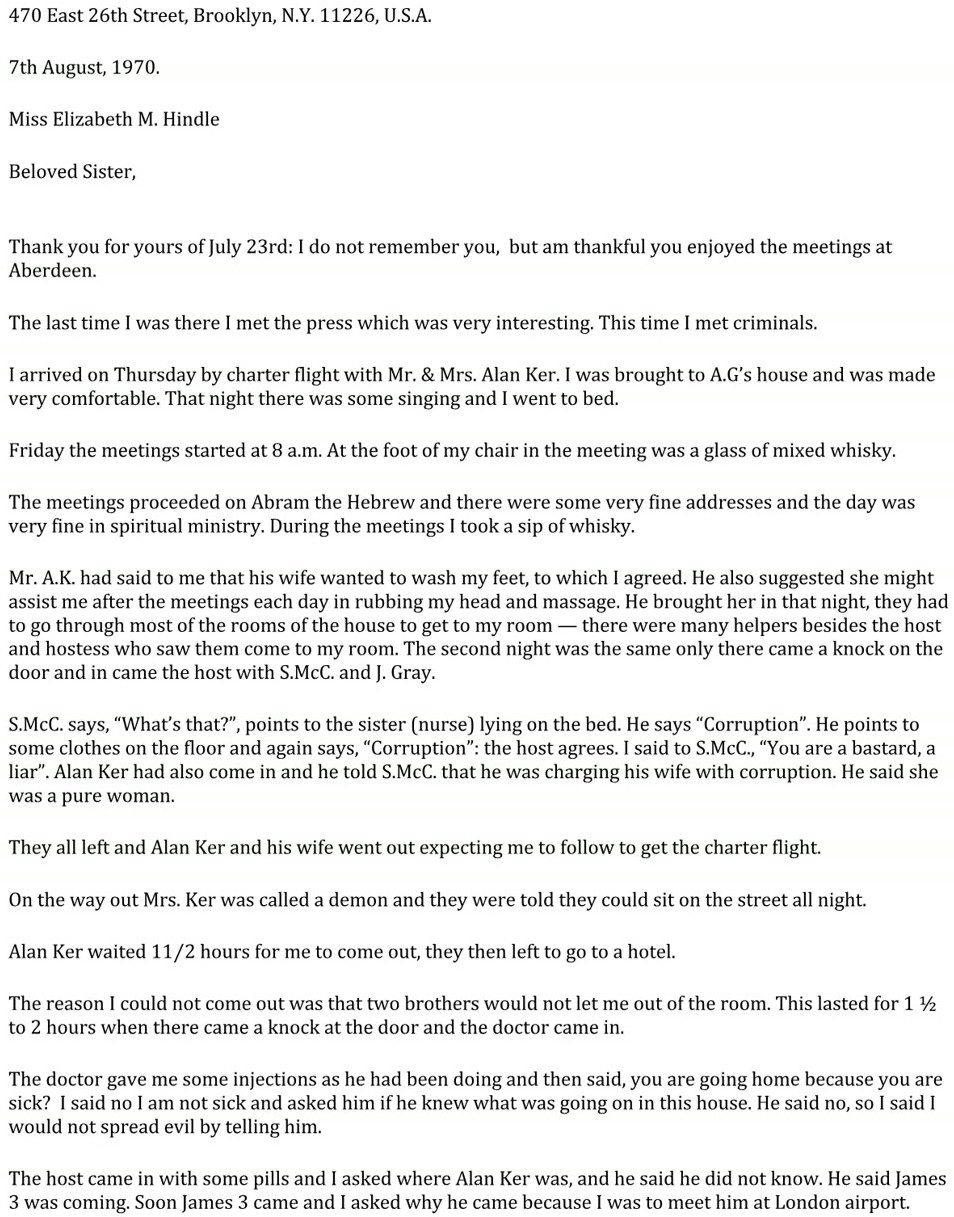
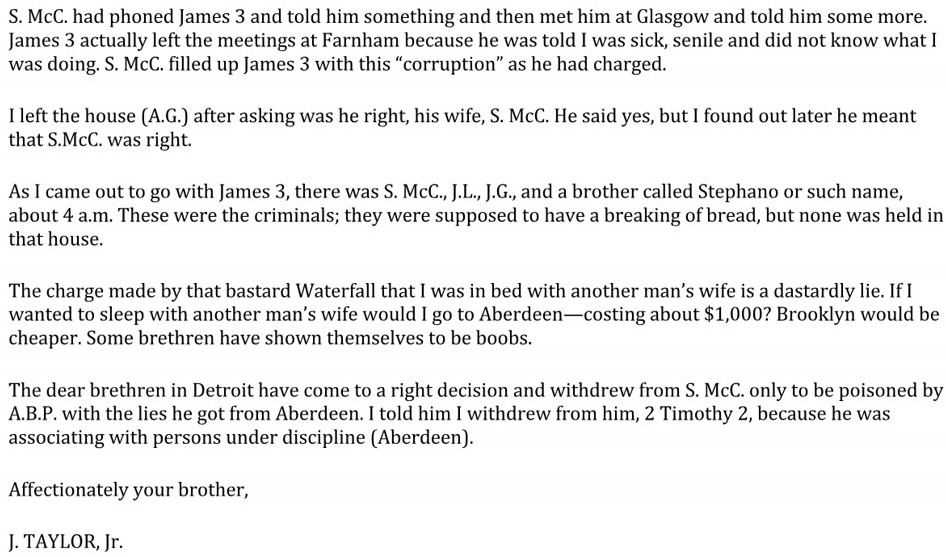
That day the Aberdeen Evening Express ran “I Am Not An Adulterer.”³¹
On the 13th, Scottish papers and BBC Nationwide carried Taylor’s line: “Nothing happened.” Beside him in the public defence stood Irene Taylor — his wife, speaking from Brooklyn to a British audience — telling the nation this was an attack of Satan on her husband; that she knew he was a pure man; that she stood by everything he had done.³²
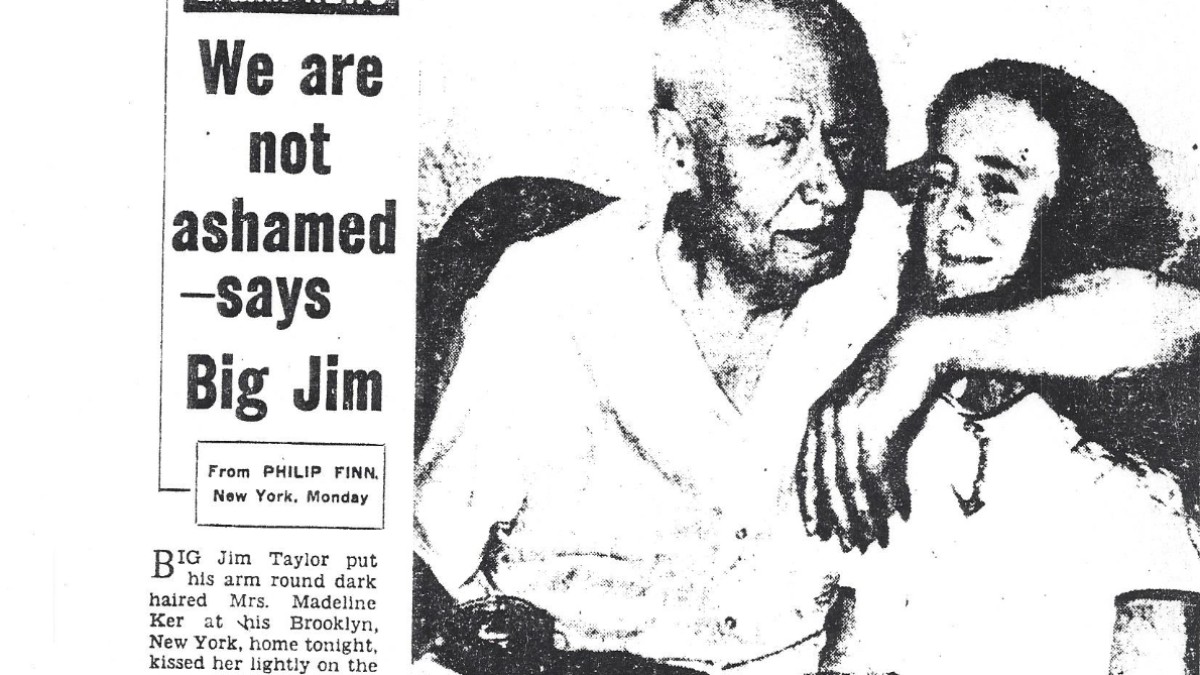
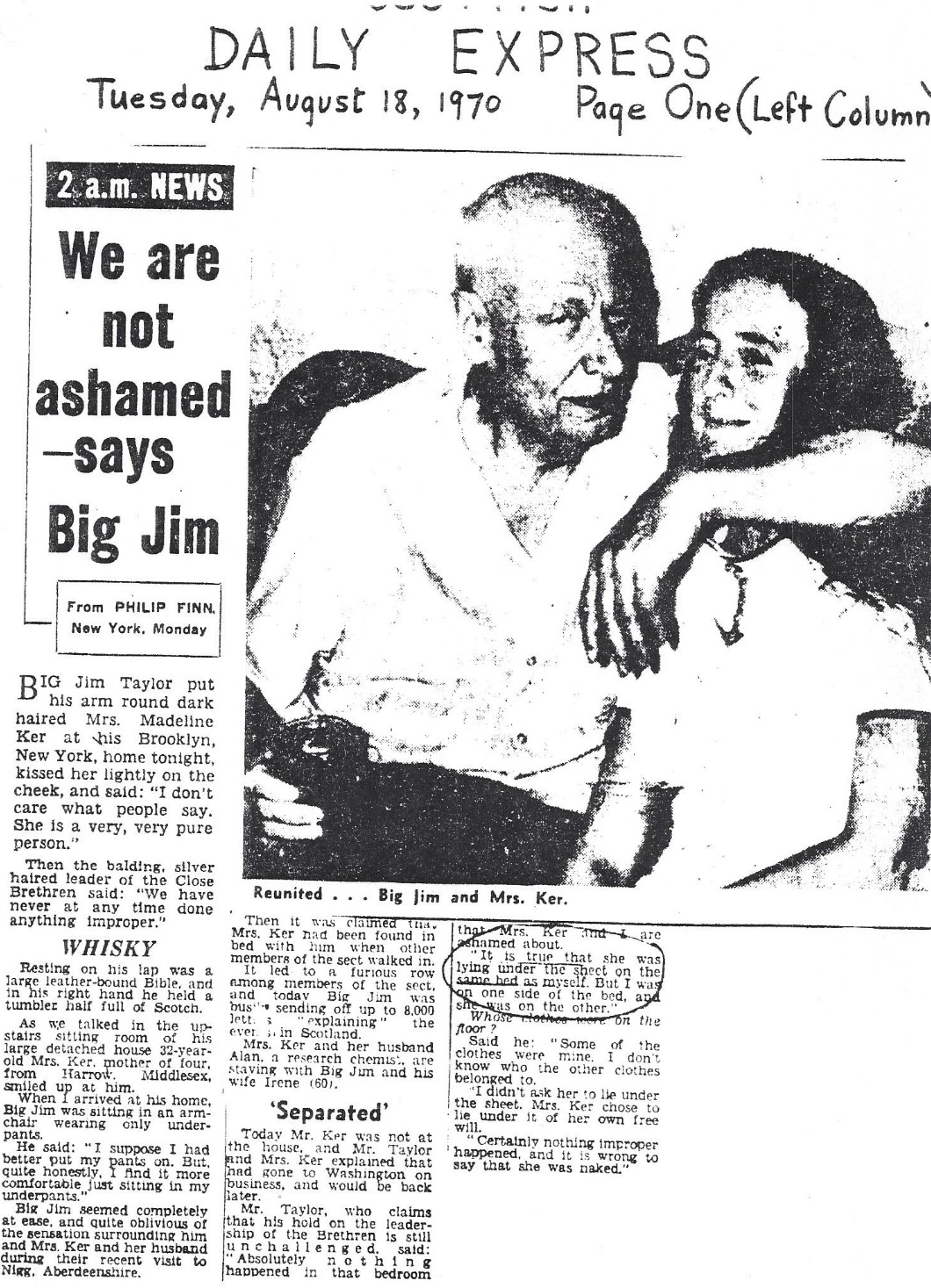
On 18 August Philip Finn of the London Daily Express interviewed Taylor in Brooklyn under the headline “We are not ashamed.” Beneath it ran the line Reunited Big Jim and Mrs. Ker. Finn found Taylor with a tumbler of Scotch in his right hand and a Bible on his lap. Taylor put his arm round Madeline Ker, kissed her lightly on the cheek, and said he did not care what people said: “She is a very, very pure person.” They had never done anything improper. “Absolutely nothing happened in that bedroom.” The photograph froze the posture for a separated people taught that the world press lies: their Man of God using that press to invert shame.³³
Then Taylor turned the police on the people who had housed him.
In mid-August he complained that he had been falsely imprisoned at Airylea. Adams traces the complaint through Edinburgh to the North Eastern Counties force. Other printed letters put the date at 15 August and name Chief Superintendent Bus in Aberdeen, listing Gardiner, McCallum, Lovie, Thomson, and Steedman as the men to be investigated. In Falkirk, Ted and Joan Steedman say officers questioned them for an hour and a half. Steedman wrote that it was “an attempt to criminalize us and set aside testimony.” The police took no action on the Aberdeen complaint.³⁴
Read in order, the summer’s pattern is plain. On 12 August the Hindle letter called the hosts criminals. Through the middle of the month the press carried purity. Then came the police complaint, and the Steedmans’ interrogation in Falkirk, and no charge. Anyone who still hears that the hosts were the criminals is hearing a story that was already in place before Taylor died.³⁵
On 21 August Taylor was still alive when Magnus Dawson, a loyalist elder, wrote to George Scott. Dawson reframed Aberdeen as a “cunningly devised test of loyalty, an ambush … especially in Scotland.” In the longer version Bachelard prints, Dawson says Taylor “drew all into the one ambush” and that “there was no immorality, it was all done so openly.” By then the signed host statement and the tapes had been in the post for more than three weeks. The ambush story did not invent the exhibits. It arrived afterwards to explain them away.³⁶
On 22 August, at Nostrand Avenue in Brooklyn, the assembly appealed to Taylor on disciplinary grounds. He refused priestly care. William T. Petersen later wrote that Taylor withdrew fellowship from him without witness and led his loyalist party out of the room. Margaret Wilson, Petersen’s daughter, later recorded her father opening the meeting: certain matters had come to their attention which they could no longer ignore. Taylor replied that Petersen needed a doctor, and withdrew from him. Alan and Madeline Ker continued to affirm Taylor’s version in Brooklyn.³⁷
Who heard
Where the facts were better known, Taylor’s account failed. Where relationships could be controlled by telephone and circular, the burial mostly worked.
Scottish assemblies, above all in the northeast fishing ports, largely rejected Taylor’s account. Adams wrote that Scotland “turned its back.” Michael Bachelard, in Behind the Exclusive Brethren (2008), estimated Scottish numbers falling from roughly three thousand to about two hundred, and about eight thousand leaving the exclusive branch worldwide. Steedman, closer to the ground, thought one hundred and eighty withdrew locally against three thousand who stayed, because “the facts were better known here than anywhere.” Registered meeting rooms in Scotland, on Neil Dickson’s later sociological count (Religions, 2022), fell from sixty-six to thirteen between 1970 and 1972. Rebecca Stott, whose father was in the Brethren at the time, summarised the scale decades later: a massive sexual scandal that changed the lives and history of the Brethren and many families overnight; many thousands left.³⁸
Those who left did not found a rival worldwide church. Dickson records that in 1972 the Scottish seceders themselves split, nicknamed Rentons and Frosts after their leaders, over how much of the Taylorite rulebook to keep. Many who withdrew did not remain Exclusive at all. They joined Open Brethren or other evangelical congregations, or stopped breaking bread anywhere. The people who accepted Taylor’s account, a minority in Scotland, became the seed of the body that later rebranded as the Plymouth Brethren Christian Church. Leaving fragmented. Staying inherited the letterhead.³⁹
Elsewhere the telephones and the circulars ran faster than the post. Brethren life ran on local halls and local tables. A reel in transit and a pamphlet still at the printer could not outrun a call that could cut a deputy off at an airport, or a letter that reached eight thousand homes naming the criminals. Distance from Aberdeen predicted belief. That is not mystery. That is logistics.⁴⁰
October
Petersen’s letter of 5 October 1970, printed by Adams, says that during Mrs Ker’s visit to New York the conduct with Taylor was “fully and extensively resumed, as in Aberdeen”; that Mrs Taylor felt “torn”; and that she stayed secluded while the press interviews, taping, and photographing were staged. If Aberdeen were only a one-weekend ambush, Brooklyn should have been quiet. Petersen says it was not.⁴¹
Margaret Wilson, writing fifty years later, relays her aunt Renee’s pain over Madeline Ker and over alcohol dressed up as the Lord’s direction. On Nationwide Irene Taylor had stood by a pure man. The private record her circle left does not match the broadcast. The public line is not the whole of what was known in that house.⁴²
Between 6 and 8 October, Taylor held his last New York meetings. Adams records that six days before his death he spoke of a “great clearance” and demanded a collection: a thousand dollars from one brother by cheque. His final recorded words to a meeting were: “Goodbye to you, Beloved Brethren.”⁴³
James Taylor Jr. died in Brooklyn on 14 October 1970, at about a quarter past three. Adams records a heart attack; others have written of alcohol-related disease. There is also a court story around that day. Adams cites an American source that Taylor was due in a New York court; Wilson states he died on the day he took her father to court for breach of the peace. The precise charge on the docket is not settled here from a primary filing. What matters for this piece is July and August — the weekend, the paper trail, and the burial — not the coroner’s form.⁴⁴
James Symington, a pig farmer from Neche, North Dakota, emerged as successor. By then the fellowship had already sorted into those who had seen or believed the bungalow record, and those who had been reached in time by the other story.⁴⁵
Five collisions
What the fellowship’s official memory requires is not a jury’s finding of adultery beyond reasonable doubt. It requires the believer to prefer a circular written weeks later over signed hosts, an independent house witness, a travel clock, and a hall recording made in front of five hundred people.
Who wrote first. Gardiner and McCallum signed on 29 July and sent the statement with the tapes to Parker. Taylor’s Hindle Letter, naming the hosts criminals and brushing off Waterfall’s bedroom charge as a “dastardly lie,” is dated 12 August. The Aberdeen assembly had already backed Gardiner. Both of these dated documents cannot be treated as equally early. The witnesses put paper into the post while the counter-story was still forming. The fellowship’s present teaching requires you to discard the earlier signed one.⁴⁶
Travel. In the Hindle Letter Taylor claimed he had travelled with the Kers on the charter from New York. Adams’s chronology has Taylor on one aircraft and the Kers on a scheduled BEA flight hours later. Both stories cannot be true of the same Thursday. It is a small point. It is also a place where Taylor’s later paper trail fails a clock that does not depend on loyalty.⁴⁷
Dress and words. The signed statement records both undressed, Taylor in an open pyjama top, “She is my woman.” Steedman heard “That’s my woman,” and recorded that there was never any sign of water for the claimed foot-washing. Taylor’s later line is nursing: the sister as nurse in the Hindle Letter, Abishag typology (the young woman brought to warm the aged King David in 1 Kings) circulating among loyalists, pyjamas, a covered woman, hosts who were criminals, nearly two hours of false imprisonment, and Brooklyn would have been cheaper. Put the nursing/Abishag line beside undressed / open pyjama top / “She is my woman” / no water. Both cannot stand. The believer must choose which document to discard.⁴⁸
The tape. The hall recording does not depend on anyone’s memory of a bedroom. Taylor later called it a forgery, “not my voice.” Ian Arbon, who was in the hall, said years later: “There is just no conceivable way in which the tapes could have been faked… Everybody who had been there knew that was exactly what had happened.” One exhibit; two incompatible claims about whether it is genuine. The reels were already moving through the post when the forgery claim was made.⁴⁹
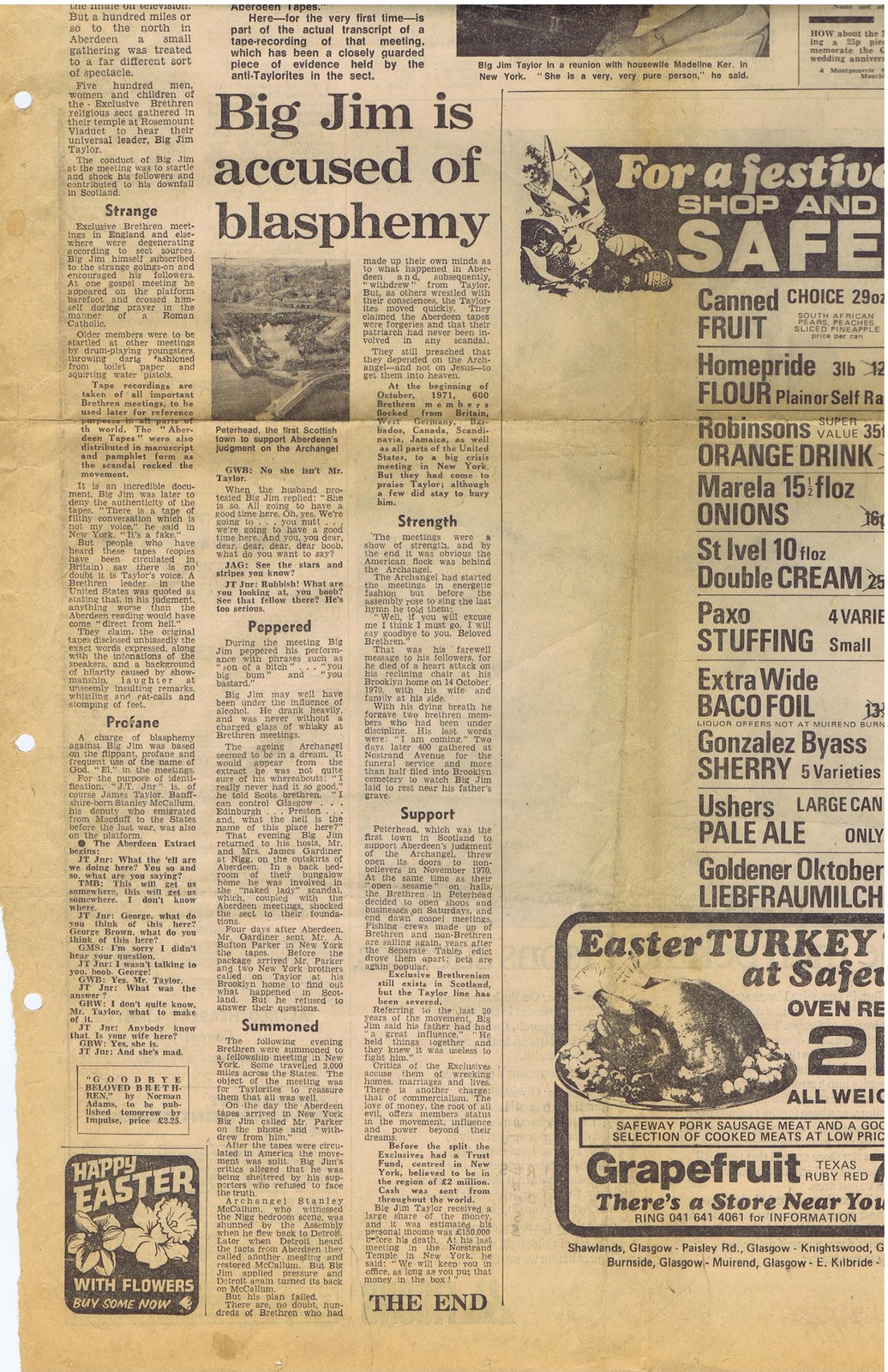
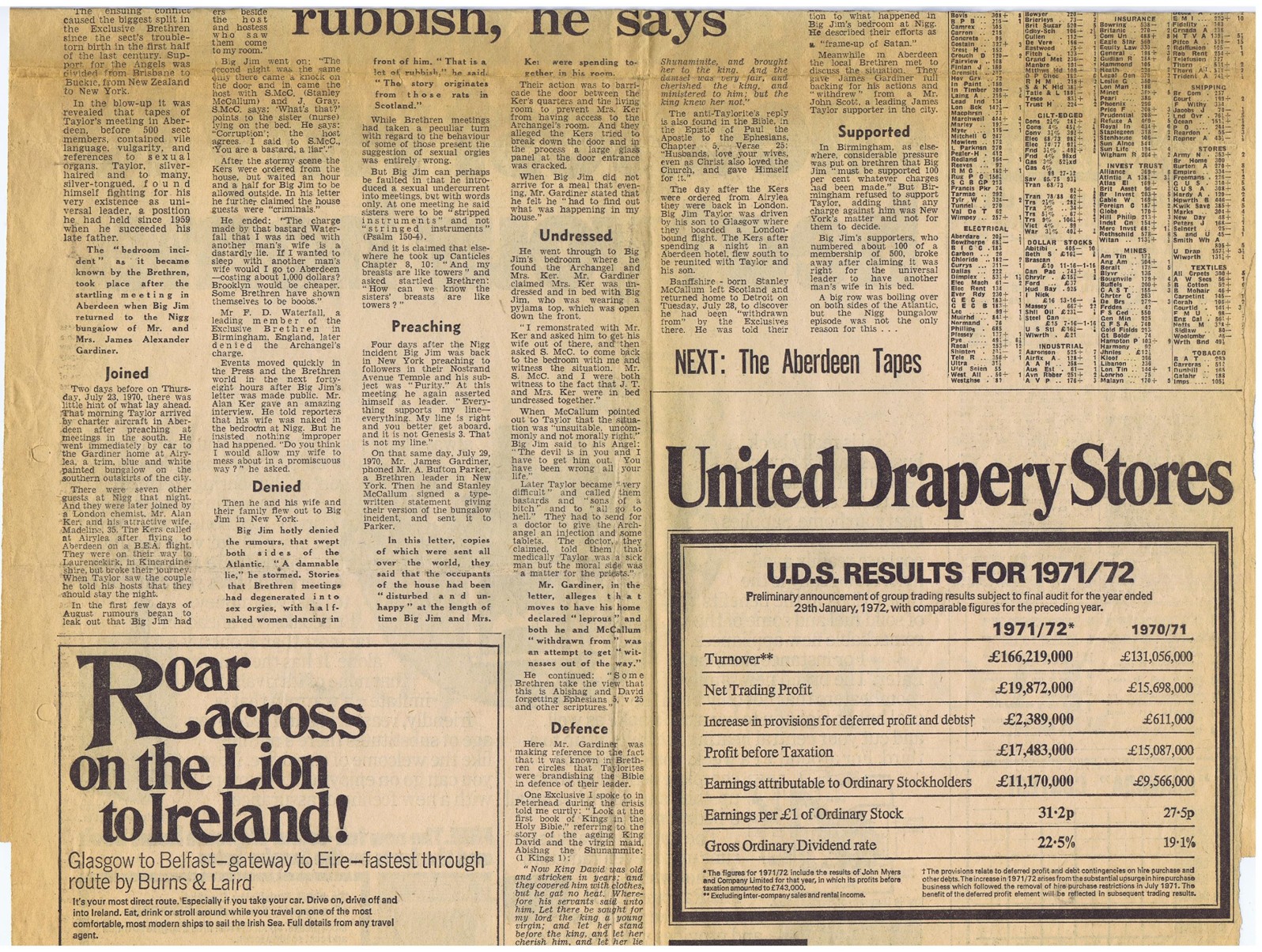
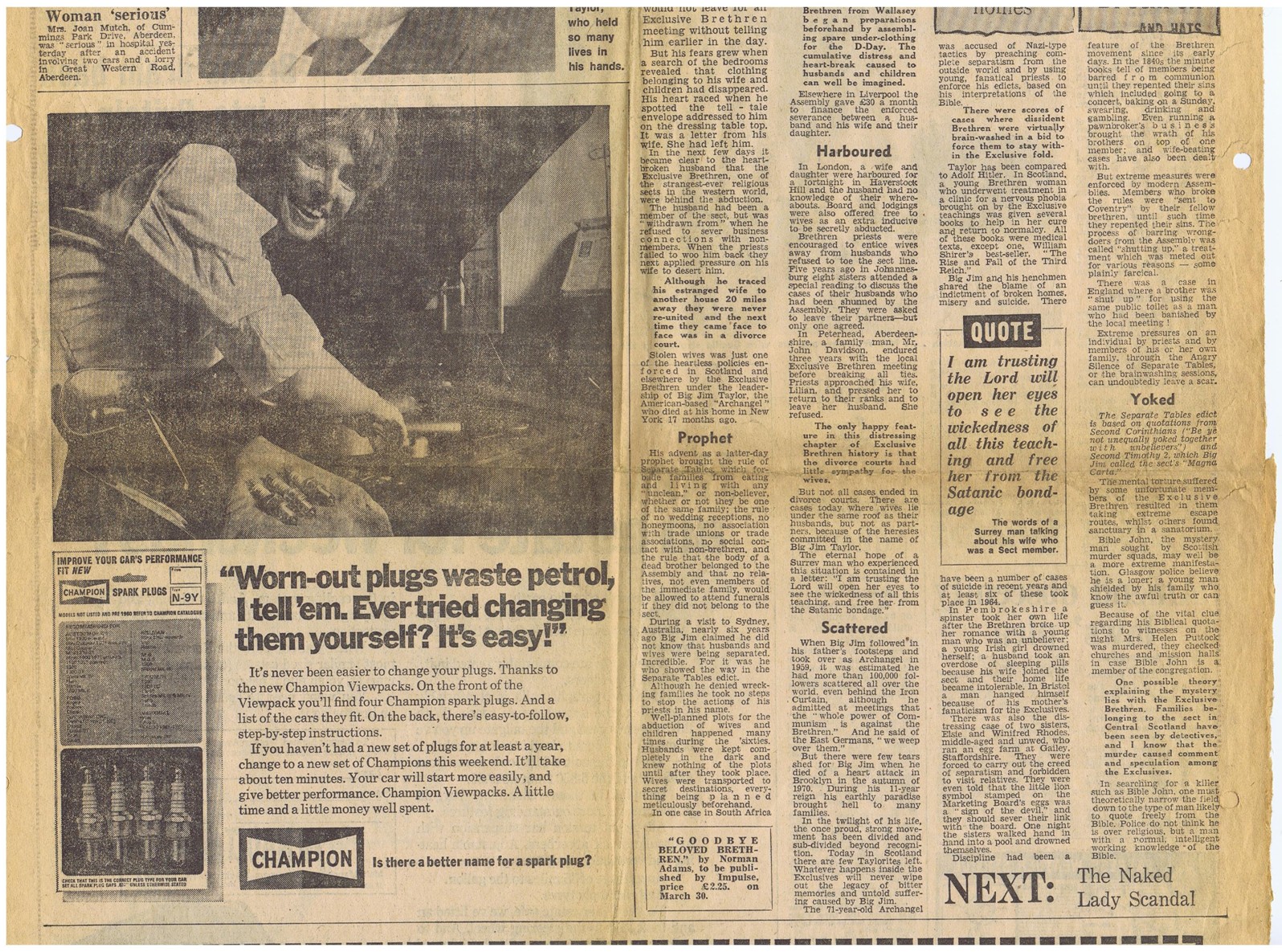
Who lost first. McCallum was withdrawn from fellowship on the Detroit tarmac before he could speak. Roger Stott was withdrawn from fellowship mid-sentence in Brighton. Parker was cut after reviewing what Aberdeen sent. Contact with the evidence became a disciplinary offence. The people who saw Aberdeen most clearly lost fastest. The people furthest from Aberdeen were told a finished story before the exhibits arrived.⁵⁰
The weekend itself has a clear spine. Friday night was access: bedroom visits, the foot-washing claim, and no water. Saturday morning was the barricade, cracked glass, and Madeline’s refusal to accept Gardiner as head of the house — the precursor, not the discovery. Saturday afternoon was the tape in the Aberdeen hall. Saturday evening was discovery with McCallum present. When Taylor later wrote of a “second night,” reading Friday then Saturday puts that night as Saturday; his press account via Adams names 25 July. The live dispute is not which calendar night. It is dress, words, the travel clock, and whether the hall recording is allowed to be real.⁵¹
Who the burial still serves
The methods of that summer did not die with Taylor.
Symington succeeded him. John S. Hales rose in the restored Taylorite line. Bruce D. Hales leads today’s Plymouth Brethren Christian Church. An internal topical concordance of Bruce-era ministry (volumes spanning roughly 2002–2012) still indexes Aberdeen under the same vocabulary: “a lie against a holy man of God”; “the ambush of Aberdeen”; host reports as “completely unsubstantial, unwitnessed, unsubstantiated, false”; the event as a test. Symington is cited as character witness for JT Jr.’s purity. The burial is still load-bearing doctrine. A believer in Sydney or Detroit who is certain nothing happened may be certain because of distance from Aberdeen, not because the 29 July paper failed.⁵²
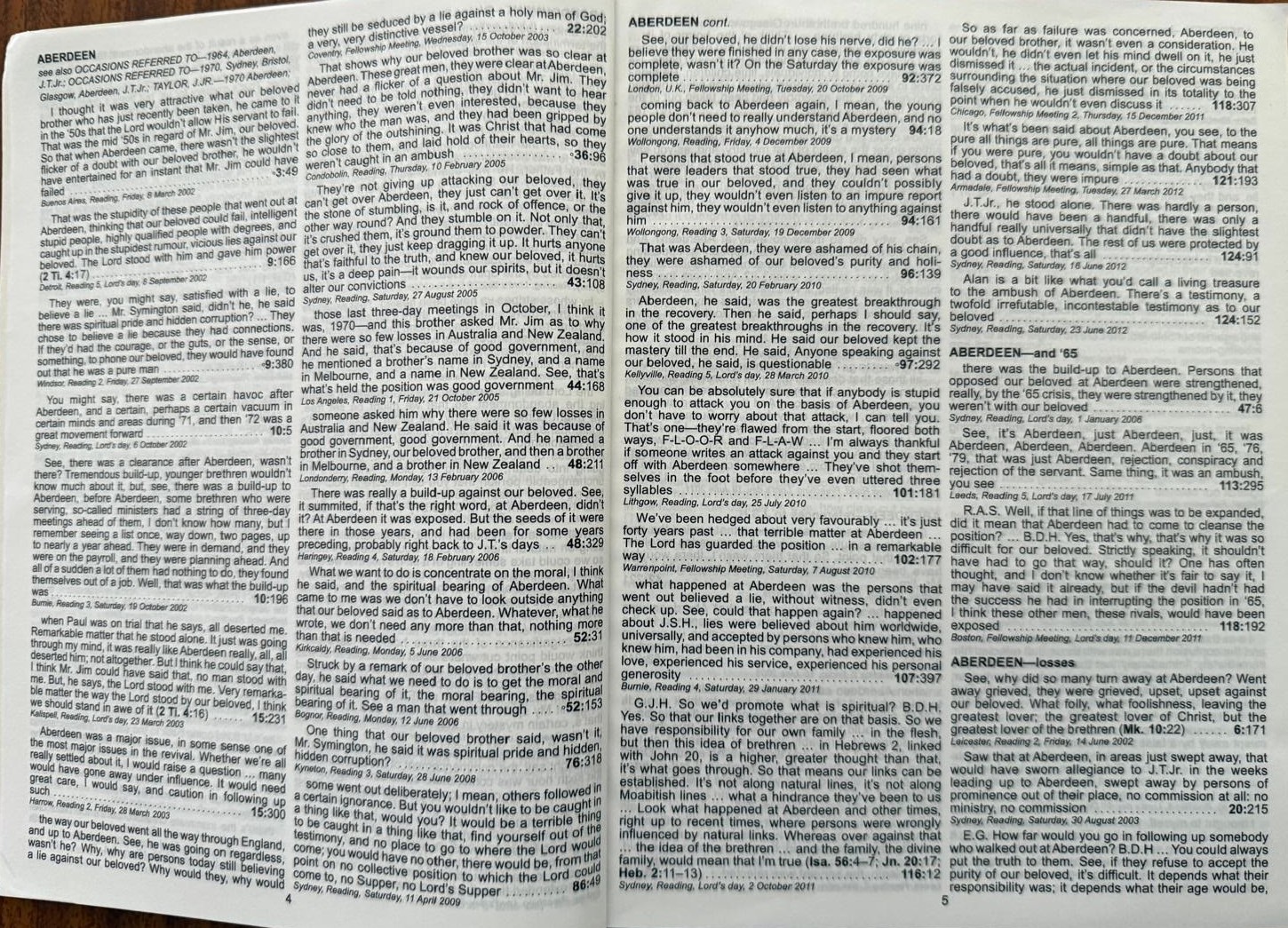
The fuller story of how those techniques were honed under later leadership belongs to the companion piece, The Shadow of Aberdeen. The minimum claim belongs here: Aberdeen is not closed history. It is a required memory.
The tape from the Aberdeen hall does not settle every dispute. It does settle that, on the Saturday afternoon before the hosts say they found her in his bed, five hundred people at Rosemount Viaduct heard their leader on record, very slurred, telling senior brethren to get to hell out of here. Where that tape and those signatures were known, the ambush story failed. Where the telephone arrived first, the concrete set.
Source Notes
- Bruce-era concordance (Bible and Gospel Trust subject index, vols. 1–130, ministry of B. D. Hales). “a lie against a holy man of God”; “caught up in the stupidity” (concordance pp. 4–5). “completely unsubstantial, unwitnessed, unsubstantiated, false”: concordance pp. 6–7. Heading ABERDEEN—test of: concordance pp. 8–9.
- Sources for the whole: Gardiner–McCallum (29 Jul 1970); Steedman letter; Hindle Letter (12 Aug 1970); Adams, Goodbye, Beloved Brethren (1972); Stott, In the Days of Rain (2017).
- Geography thesis: Steedman (“facts were better known here”); Adams on Scotland; synthesis with Stott / Hindle scale of circular reach.
- Leadership, Separate Tables, fishing ports: Adams Ch. I, IV–VI, XIV; TC §6. Age: Bachelard Ch. 2. Spouse/child table separation: Adams on Separate Tables cases.
- 2 Tim 2:19 (Darby); Adams Ch. VI; Bachelard Ch. 1.
- Pre-Aberdeen enclosure: Neil Dickson,Religions13:504 (2022), §3 (1960s Taylorite secessions); Bachelard,Behind the Exclusive Brethren(2008), Ch. 1 (“profitable losses”).
- Arrival, Airylea, Steedman loyalty / “everything to lose”: Adams Ch. XIV; Gardiner–McCallum statement (PDF); Steedman letter (PDF).
- Thursday evening before Kers; “I am a pure man…”: Steedman letter — Ted Steedman witness letter, 1970 (PDF).
- Kilmarnock May 1970: Bachelard Ch. 1 (Robertson unpublished ms.The Life of a Nobody, 2008; age given as 11). Mark Nicol,Mail on Sunday, 27 Jan 2013 (Robertson; age given as ten; PBCC denial of the allegation and of the Kilmarnock visit).
- Kers BEA 9:30 p.m.; bedroom: Adams Ch. XIV; Gardiner–McCallum; Steedman.
- Friday dawn / intervals / Rosemount: Gardiner–McCallum; Adams Ch. XVI.
- Whisky, foot-washing, 11 p.m., three hours: Hindle Letter; Gardiner–McCallum; Steedman.
- “Never any sign of water taken in”: Steedman letter.
- Barricade, glass, insult; Steedman on denial cracking Taylor: Gardiner–McCallum; Bachelard Ch. 1; Steedman.
- Saturday tape conditions: Adams Ch. XVI; Steedman; TC §2.
- Hall highlights video with English captions. Full Saturday afternoon meeting (archival length, ~76 minutes): Listen to the full meeting.
- Bedroom discovery: Gardiner–McCallum; Adams Ch. XV; TC §5; Steedman.
- Doctor: medically sick / moral side for the priests: Gardiner–McCallum; Adams Ch. XV.
- James 3, departure, fare, no breaking of bread, Steedman weeping / “exposure was of the Lord”: Gardiner–McCallum; Adams Ch. XV; Hindle; Steedman.
- Gardiner concluding points: Adams Ch. XV.
- Stott / Depot / “Hales supporters”: Stott pp. 228–232; Adams on Stow Hill.
- Bruce D. Hales / PBCC continuity: Stott; Bachelard; concordance extract.
- Brighton 28 Jul; pamphlet: Stott pp. 228–234; If We Walk in the Light intro — pamphlet PDF.
- Destroy-order cover note: If We Walk in the Light (1970) — read the pamphlet PDF.
- Stott intro, printed p. 58: 100% support; Maynard upper garment; Storr against enquiry — If We Walk in the Light (PDF).
- Brighton inquisition, printed p. 60: “Are you 100% with J.T.Jr.”?; “J.T.Jr. is the issue.” — If We Walk in the Light (PDF).
- Statement to Parker; Aberdeen backing; Nostrand “Purity”: Adams Ch. XV–XVI.
- McCallum Detroit tarmac withdrawal: Adams Ch. XV–XVII.
- Parker withdrawal; tape forgery claim after reels posted: Adams Ch. XV–XVII.
- Hindle Letter quotes (criminals / Waterfall / dastardly lie / Brooklyn cheaper): Adams Ch. XIV — Hindle Letter (PDF).
- Evening Express 12 Aug: Adams Ch. XIV; TC §4.
- Nationwide: Adams Ch. XV; TC §3.
- Finn Daily Express 18 Aug (whisky, arm, pure person, nothing happened): Adams Ch. XV — Daily Express, 18 Aug 1970 (PDF).
- Police complaint; Falkirk interrogation; Steedman “criminalize us”: Adams Ch. XIV; Ep. 83; Steedman.
- Dawson ambush letter 21 Aug 1970: Bachelard Ch. 1 (extended quote); shorter form via Bachelard / timeline. Dawson later excommunicated 1972 (Bachelard note).
- 22 Aug Nostrand / Petersen: Adams Ch. XVIII; Petersen via Adams; Wilson 2020.
- Scotland numbers: Adams; Bachelard Ch. 1; Steedman; Neil Dickson, Religions 13:504 (2022); Ep. 143 (Stott).
- Leavers scatter: Dickson, Religions 13:504 (2022), p. 8 (Rentons / Frosts, 1972; Open Brethren absorption). Loyalist remnant as seed of later PBCC: Bachelard Ch. 1–2; Dickson Table 4.
- Geography / relationship control: synthesis from Adams, Steedman, Stott, Hindle scale.
- Petersen 5 Oct Brooklyn reprise: Adams Ch. XVIII.
- Irene public vs private: Nationwide via Adams; Petersen; Wilson 2020.
- Last meetings; “Goodbye to you, Beloved Brethren”: Adams Ch. XIX.
- Death / court: Adams Ch. XIX; Bachelard; Stott; Wilson.
- Symington succession: Adams Ch. XIX; Bachelard.
- Chronology of exhibits: Adams Ch. XIV–XVI; Hindle Letter date.
- Travel conflict: Adams Ch. XIV; TC §4.
- Dress and words vs nursing/Abishag: Adams Ch. XIV–XV; Gardiner–McCallum; Steedman (no water); Hindle “sister (nurse)”; Abishag typology in loyalist circulation (Steedman on Ian Gibb / 1 Kings; Adams).
- Forgery claim vs Arbon verified quote (Ep. 143, 01:17:34): Adams Ch. XVI; Ep. 143 Q3b.
- Withdrawal cascade: Adams Ch. XV–XVII; Stott Brighton.
- Gardiner–McCallum; Steedman; Hindle “second night” sequential reading; Adams on 25 July press account.
- Continuity bridge: Symington to John S. Hales to Bruce D. Hales; Bachelard on dynasty.
Reader Alerts